
Making implicit explicit: Design research on the social context of public signs.
2026
Prague, Czech Republic
Public spaces increasingly rely on written instructions to regulate human behaviour. Streets, transport systems, public buildings, and commercial environments are populated with directives that prescribe how individuals should move, wait, queue, dispose of waste, or interact with others. These systems are often regarded as neutral components of urban infrastructure, designed primarily to improve efficiency, safety, and accessibility. Yet their ubiquity raises broader questions about the relationship between design, authority, and social behaviour.
The contemporary city no longer depends solely on tacit forms of knowledge to sustain everyday interactions. Instead, behaviours that were previously negotiated through shared cultural understanding are increasingly communicated through explicit instructions. This shift extends beyond questions of legibility or wayfinding. It represents a transformation in the manner through which social norms are produced, maintained, and enacted within public life.
Tacit knowledge emerges through repeated participation within a community. Individuals learn how to behave not because every situation has been prescribed, but because patterns of interaction become familiar through observation, repetition, and experience. These forms of understanding rarely require articulation. They exist within ritualised behaviours that allow people to navigate shared environments while continually exercising contextual judgement. Such knowledge cannot easily be reduced to written rules because it depends upon circumstance, interpretation, and the presence of others.
Byung-Chul Han argues that rituals once provided symbolic structures through which communities were organised without requiring continuous communication. Their significance lay not in the transmission of information, but in their capacity to establish shared meaning through repetition. As rituals diminish, symbolic knowledge becomes increasingly externalised into systems of instruction. Rather than allowing individuals to interpret situations through experience, contemporary public environments communicate appropriate behaviour through visible directives. Moral conduct therefore becomes associated with compliance rather than internalisation.
Street signage provides a particularly revealing example of this transformation. Roads and transport systems constitute some of the most explicitly regulated environments within everyday life. Their visual language has become so familiar that it rarely attracts conscious attention, despite continuously organising movement and interaction. A pedestrian crossing sign, for example, does considerably more than indicate where a road may be crossed. It establishes rights of movement, distributes responsibility, and removes the need for informal negotiation between pedestrians and drivers. The social interaction remains, but its organisation has been transferred to the infrastructure itself.
This transfer of responsibility is central to understanding the broader cultural implications of public information systems. Individuals continue to participate in shared environments, yet increasingly do so through instructions issued by external authorities. Behaviour becomes mediated through signs, markings, recorded announcements, and digital interfaces that define appropriate conduct in advance of any social encounter. Decisions that might otherwise require attentiveness to context are resolved through predefined systems of communication.

The familiar instruction displayed on public transport—”Give up your seat to those who need it more than you”—illustrates this distinction. The behaviour encouraged by the sign remains socially desirable, yet the basis upon which it is enacted changes. Instead of recognising another passenger’s needs through observation and judgement, individuals are reminded by an institutional voice that prescribes the appropriate response. The action itself may remain unchanged, but its relationship to social intelligence becomes more complex. Moral behaviour is increasingly framed through obedience to an external directive rather than through situated judgement.
A similar dynamic can be observed in everyday gestures such as holding an elevator door for another person. Ordinarily, such actions are accompanied by subtle acknowledgements that establish mutual recognition between strangers. Gratitude, hesitation, urgency, and circumstance all contribute to the meaning of the interaction. If an instruction were introduced requesting that users hold the door for others, the behaviour would continue to occur, but its symbolic value would shift. What was previously understood as a voluntary expression of consideration becomes an expected obligation articulated by authority. The interaction is preserved, while its social character is altered.
These examples do not suggest that public information systems are inherently problematic. Modern urban environments require coordinated infrastructures capable of communicating efficiently across diverse populations. Signage performs an indispensable role in maintaining accessibility and public safety. The question is not whether such systems should exist, but how their increasing prevalence influences the ways individuals develop social judgement within shared environments.

Erving Goffman’s concept of civil inattention provides an important framework for understanding these dynamics. Civil inattention describes the ritual through which strangers acknowledge one another’s presence while simultaneously respecting personal privacy. Such behaviour cannot be reduced to explicit instruction because it depends upon sensitivity to context and repeated social performance. Individuals acquire these behaviours through participation rather than prescription. They become embedded within everyday life precisely because they are rarely articulated.
The gradual replacement of tacit knowledge with explicit directives therefore raises questions about the future of these forms of social intelligence. As contemporary environments become increasingly regulated through written instruction, surveillance technologies, and behavioural guidance systems, opportunities for exercising contextual judgement may diminish. Public behaviour risks becoming organised around compliance with visible authority rather than responsiveness to the immediate social environment.
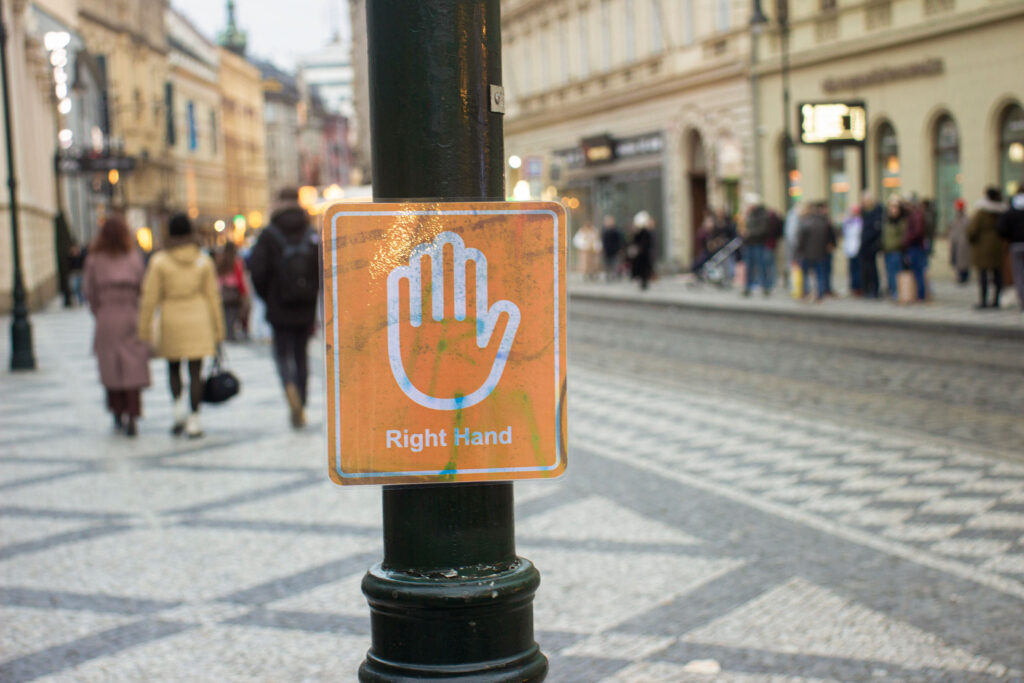
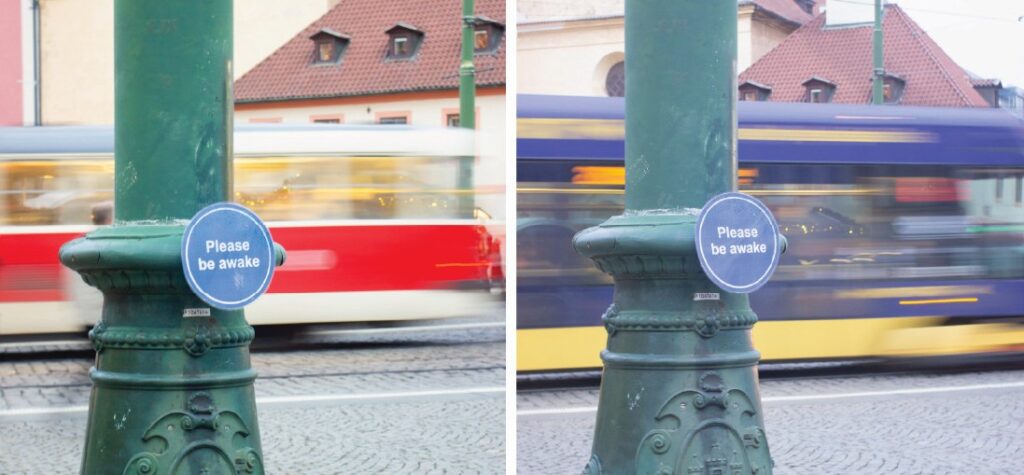
To investigate these questions, my research adopted a methodology of research through design. Rather than analysing existing communication systems in isolation, the project introduced a series of experimental interventions into public space. The objective was not to produce graphic artefacts or speculative installations, but to operate within the visual language of existing street infrastructure. By preserving familiar characteristics such as typography, proportion, colour, materiality, and tone of voice, the interventions examined how authority is established through design conventions that often escape conscious attention.
The prototype signs were installed across transport networks, streets, bridges, and public squares in Prague. Their messages subtly altered familiar directives without abandoning the conventions through which public signage derives its credibility. Observing public responses revealed that the majority of interventions attracted remarkably little attention. Their familiarity allowed them to merge with the surrounding infrastructure, reinforcing the argument that the authority of public signs depends not solely upon their content but upon their integration within broader systems of urban communication.
These findings suggest that the transformation described by Han should not be understood simply as the disappearance of ritual. Everyday social behaviours continue to be enacted through repetition, habit, and shared expectations. Giving up space, avoiding prolonged eye contact with strangers, or negotiating movement through crowded environments remain ritualised performances embedded within public life. What appears to be changing is the relationship between these rituals and the communication systems that increasingly surround them. Tacit knowledge has not disappeared; it is being reconfigured alongside expanding infrastructures of instruction, surveillance, and behavioural regulation.
Understanding this transformation requires attention not only to the messages displayed in public space, but to the design systems that communicate them. Signs are never neutral objects. They participate in broader relationships between authority, trust, and social organisation. Examining their role therefore provides an opportunity to reconsider how public environments might facilitate social intelligence rather than prescribe behaviour.